

Abstract
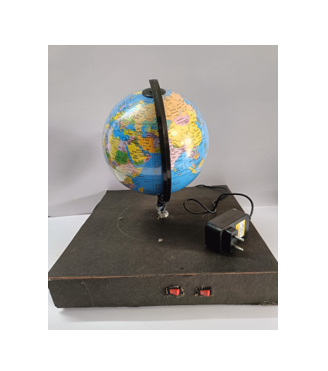
The Geostationary Satellite Science Project explores the concept, design, and applications of geostationary satellites that orbit Earth at the same rotational speed as the planet, allowing them to remain fixed over a specific location. This project covers the fundamentals of satellite orbits, the physics behind geostationary positioning, and practical uses such as weather monitoring, communication, and broadcasting.
Objectives
-
Understand the principles of geostationary orbits and satellite mechanics.
-
Demonstrate how geostationary satellites maintain fixed positions relative to Earth.
-
Explore real-world applications of geostationary satellites in communication and weather forecasting.
-
Develop a simple model or simulation to visualize satellite orbit and positioning.
Materials and Components
-
Satellite model or globe for demonstration
-
Motorized stand (for orbit simulation)
-
LED lights (to simulate satellites)
-
Microcontroller (optional, for interactive models)
-
Diagrams and charts explaining orbital mechanics
-
Software tools (like Stellarium or satellite simulation apps)
Working Principle
A geostationary satellite orbits Earth at approximately 35,786 kilometers above the equator, matching Earth’s rotation period of 24 hours. This synchronized motion makes the satellite appear stationary relative to a point on Earth’s surface, which is ideal for continuous communication and observation. The satellite’s orbit lies in the equatorial plane and is circular.
Methodology
-
Explain the concept of satellite orbits, focusing on geostationary orbit characteristics.
-
Use models or simulations to demonstrate how a satellite maintains position over a fixed point.
-
Show how geostationary satellites facilitate global communication and weather monitoring.
-
Conduct simple experiments or use animations to visualize orbital paths.
Applications
-
Satellite TV and radio broadcasting
-
Weather and climate monitoring
-
GPS and navigation aids
-
Military and emergency communication
Future Scope
-
Study advancements in satellite technology like higher bandwidth communication.
-
Explore geostationary satellite constellations for global internet coverage.
-
Analyze the impact of satellite debris on geostationary orbits.
-
Investigate next-gen satellite propulsion and maintenance systems.
Order Now!
Upgrade your network experience today with the Geostationary Satellite Science Perfect for improving connectivity and ensuring seamless communication.
To Explore More Visit our Website
For more information:-www.mifraelectronics.com





Reviews
There are no reviews yet.