


Arduino-Based Traffic Configuration System
Traffic congestion remains a serious challenge in urban areas. Often, this issue arises due to poorly timed or manually operated traffic lights. To address this, the Arduino-Based Traffic Configuration System provides a cost-effective and automated solution for traffic management.
This system uses an Arduino Uno, LEDs, and a basic control algorithm to simulate a real-world traffic light setup. In addition, it can later be expanded with sensors to handle real-time traffic data.
Working Principle
The system follows a simple four-way signal logic:
-
Firstly, each road has Red, Yellow, and Green LEDs.
-
The Arduino Uno controls which light is active and for how long.
-
For example, Green stays on for 10 seconds, Yellow for 3 seconds.
-
Afterward, Red lights activate for the remaining time.
-
Consequently, each direction gets a turn, and then the cycle repeats.
Methodology
-
Designing the Traffic Flow
-
Each lane is assigned a signal with set durations.
-
As a result, traffic moves in an orderly manner.
-
-
Programming the Arduino
-
Code is written to control LED transitions using timing functions.
-
Therefore, the sequence flows smoothly without overlaps.
-
-
Circuit Setup
-
LEDs connect to Arduino pins through resistors.
-
A USB cable or battery powers the entire setup.
-
-
Loop Execution
-
The program repeats the signal cycle endlessly, ensuring continuous control.
-
-
Fully automated control using Arduino
-
Low-cost and beginner-friendly
-
Easy to expand with real-time sensors
-
Mimics real-world traffic logic accurately
-
Improves road safety and efficiency
Hardware Used:
-
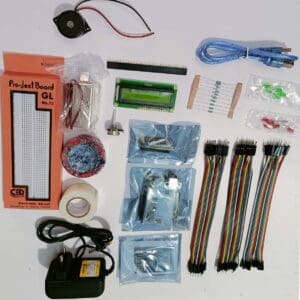
Arduino Uno
-
Red, Yellow, Green LEDs (x12)
-
220Ω Resistors
-
Breadboard
-
Jumper Wires
-
USB Cable / 9V Battery
Applications:
-
Educational model for students
-
Traffic control simulation in smart cities
-
Prototype for sensor-based traffic systems
-
Embedded systems training project
To Explore More Visit our Website
For more information:-www.mifraelectronics.com


Reviews
There are no reviews yet.